Brasilia
My first impression was not the most auspicious. After a gruelling journey I wanted arrival to be hassle-free, so, rather than deal with Uber meeting places — a nightmare at some airports — I chose the more expensive option of a car from the official taxi rank. The driver’s advance quote of 60 reais for the ride to Play Hotel was a first taste of the capital’s extortion. Admittedly it was nighttime and the drive was not going to be short, but even compared with the cost of those epic city treks in expensive São Paulo this was a steep fare for 2023. This and other mullings occupied my soggy mind as I peered out of the car’s window trying in vain to make out some sights of the ultramodern Brazilian capital in the dark.
At length the car slowed down in what looked like an industrial estate and came to a stop outside an unlit building. No sign was visible for my accommodation — which I knew to be named Play Hotel — or indeed any other sign. Before alighting I asked the driver if he was sure this was Play Hotel; he said he was. Unconvinced, I asked again as I was paying him, and again he reassured me as he gave me my change. Gingerly I hauled my three suitcases into what looked encouragingly like a hotel’s lobby and I asked the man at reception if this was Play Hotel. He, too, reassured me that this was the place and he set about checking me in, a procedure which can be bizarrely time-consuming in Brazilian hotels. This one took even longer than usual. After much tapping into his keyboard and sliding his mouse, he had to admit that he could not find my reservation on his system. Then it was he who asked “Do you think you have got the right hotel?” I found the confirmation on my mobile phone and showed it to him. This prompted him to announce, with an air of satisfaction that seemed misplaced in the circumstances, “that is Play Hotel”. To my despairing protestation that that was precisely what I had been saying from the start, he replied by showing me his hotel’s name printed on a piece of paper: B-Hotel. Yes, B-Hotel. I looked around in disbelief, wordlessly appealing for a witness to the surreality of it, but the few people sitting or standing or passing through the lobby were busy about their business, just like in a bad dream where you are excluded from the reality that surrounds you. What, in the name of all the saints, sounds alike between “Play” and “B”? By what perverse short circuit can two people, separately, have heard “B” every time I said “Play”? If they had to mishear me, I might understand the driver taking me to Pay Hotel, or Clay Hotel, or May Hotel, or even Beige Hotel. Then it would have been frustrating, but understandable for the receptionist to reassure me that I was in the right place and to try to check me in, as had just happened. But B-Hotel?
Back on the pavement with my three suitcases, I was trying to order Uber — I was not going to entrust myself to any Brasiliense ears again — when another taxi materialised before me. I asked the driver how much to Play Hotel, this time showing him the address on my mobile phone. The figure quoted — 100 reais — sounded so random that I went back to the Uber app and persevered until the fare showed: 40 reais. The taxi driver was still waiting. He took umbrage when I told him Uber’s figure. “Oh, yeah, but they will cancel.” I said I would take my chances. He glowered as he revved up his engine and repeated his omen: “they will cancel”.
Contrary to the soothsaying, Uber did not cancel and I was finally delivered, past midnight, at Play Hotel. It was in Águas Claras, a more promising part of town than the industrial estate I had just been at. The bad news came when I asked at reception about a place to eat. The man put on a commiserating face. “At this time you’d be pushed. Maybe delivery.” The options for delivery late on Sunday night were close to zero, but to go to bed on an empty stomach was out of the question. The balance of supply — next to nil — and demand — starving — dictated that I had to settle for Burger King, gluten and all, a decision that was to prove ill-advised.
The next ten days in Play Hotel were spent looking for more sustainable accommodation. After much searching I settled for lodgings in the Lago Norte area. When Uber came to pick me up, the driver refused to take me because of my three suitcases. He said that I had selected the wrong category and that I should go back to the app, cancel the ride and book again selecting Becks. And he drove off, unconcerned about all the baggage I had dragged onto the road for his benefit. The next challenge was to find the Becks option on the Uber app. It was only after quite a few iterations that it occurred to me to scroll lower than I had ever done, and up came the service the Uberman must have been referring to: it was Bags. Another jewel of sonic transmogrification in Brasília. On rebooking — at nearly twice cost — lo and behold, who came for me if not the same driver driving the same car. He must have stayed around the corner, waiting for me. As he was organising my suitcases in his boot, he showed injured pride when I asked if the purpose of the higher fare was to pay for this help — as if it were he who was the injured party. We got off to a false start, he and I, but once we were on our way he displayed unexpected humanity as he expatiated on the social ills of his native city, Belém do Pará.
When I and my Becks were safely in the flat, it was a pleasant corroboration to find it, as advertised, spacious, well-ventilated and graced with a view of green hills, hence the name of the condominium — Green Hills. Much English in Brasília, which is fine when it is written, but a hazard when spoken. When an impenetrable word or phrase leaves me floundering for a meaning, the chances are that it is in English adapted to the local phonetics, such as estorahjee for storage, keshibecky for cashback or Méqui for MacDonald’s. Why this was not a problem until I came to Brasília is not something I will attempt to elucidate here.
Lago Norte piqued my curiosity about the famed Brazilian capital. Where was it? A few days into my stay, a family friend treated me to lunch in a chic restaurant located in the Asa Sul area. There I could see rows of shops. He then gave me a guided tour of the seats of political power and the Cathedral, most of them designed by Oscar Niemeyer and all architectonically impressive. But my mental question remained unanswered: where was the city? A month’s sojourn in Lago Norte, and another in Asa Sul, did nothing to enlighten me.
Contrary to what you might expect given the much smaller population — just under three million — and the steadier pace of life, people in Brasília are, on the whole, less friendly than those in São Paulo. Immigrants from other states often make the point that the capital’s inhabitants are offhand and mistrustful. Having been exposed to much greater doses of those qualities before I came to Brazil, I had not noticed that trait until it was pointed out to me, and even then, I could only recognise it in terms relative to the disarming warmth that greets you in other parts of Brazil.
Over time I had occasion to be perplexed by the nomenclature of addresses. Instead of neighbourhood, street and number, you might get something like SHIN CA-9 Bloco P. That means, among other things, that when you are coming out of the metro and have to choose which exit to take, you will see signs showing you not helpful words such as north, south, or such-and-such referential landmark, but a combination of letters and numbers looking like an algebraic formula. At the city’s planning stages, the main avenues were mooted to bear names of historical significance, such as Bandeirantes or Independência, but another idea prevailed instead, leading to their encryption as ERW, L3, W3 and all the other names you now see. The practical difference between the original, commonsense approach and the one that prevailed can perhaps only be assessed by those who have spent their time trying to find their way around in Brasília. The city’s founding fathers, if you ask me, have a lot to answer for.
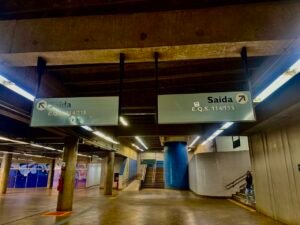
Yes, there is a metro line, and it works well. The stations are clean and spacious and each platform has a screen showing you the true times of the next few trains. The line bifurcates at Águas Claras and continues westwards towards either Ceilândia or Samambaia. On the east the line stops at Conjunto Nacional, a large shopping complex which for all I know may be the nearest Brasília has to a city centre. There is plenty of city to the northeast of that, making you wish the metro line went a lot further. There are buses going east, but they don’t go everywhere and their adherence to timetable is haphazard.
The front car of the metro is for women only, something you are expected to know. I did not, and only discovered it when a guard (male) came up and asked me to move to the next car. Another unwritten rule of the metro is that all the seats are deemed to be preferential, that is, priority seating for the pregnant, the physically challenged and the old. This one is universally disregarded. But the main drawback of travelling by metro is the hustlers, a feature of Brazilian public transport that even Brasília is not exempt from.
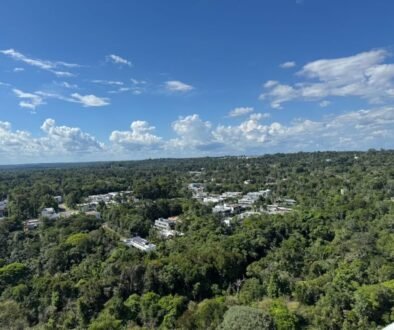
You have to hand it to Brasília, it is a clean, orderly city. You would be hard put to find any litter on its pavements. Its traffic on the whole follows the rules and the sound of a horn tooted is a rarity. It is also the greenest city I know. As well as having probably the best ratio of trees per inhabitant, it has generous provision for bicycle and pedestrian traffic. Although it has much exceeded the population projected by its planners, there is no sign of overcrowding, or none that I have witnessed. Many’s the time when I walked to or from the metro station along tree-lined walkways without meeting a soul. In fact, whole areas often struck me as deserted to the point of dereliction, particularly at weekends. And, in spite of the city’s young age — founded 1960 — there are places that look like they have been abandoned altogether. One such place which I went past on buses is signposted Florida Mall.
Spartan in many ways, the Brasília experience has been relatively generous to me in one respect: gluten-free cafés. I could not believe my luck when I first entered Quitutices, somewhere in Asa Sul — I will not attempt to give you the logarithmic address. The coffee is decent and all the cakes and pies are made with alternative flours. Over time I discovered another, Passos Sem Gluten, providentially located right around the corner from where I was staying in Águas Claras. Once I discovered this jewel I returned to it as often as I could, partly for the pleasure of their good coffee and cake, partly to support their noble enterprise.
There are, of course, cultural venues of some importance. I found that Teatro Municipal is closed for refurbishment. Its resident orchestra is giving regular concerts elsewhere, the programmes an odd admixture of adventurous and crowd-pleasing. As I write, the fare on offer consists of popular classics, arrangements of tango, rock and film music. Nothing to motivate me to attend. The orchestra’s director, Cláudio Cohen, is the first musician I have come across who bestows on himself the title of Maestro when introducing himself on his daily radio programme. Bruxa que é bruxa não diz o que é, says the poet Ricardo Aleixo — a witch who is a witch does not say what she is. There is, or there appears to be, another orchestra, the Philharmonic, but I found no traces of its current life, and its website seemed to be dormant.
After Asa Sul, I had a sojourn in a village just outside the city, Grande Colorado. I also had spells in Taguatinga and then back in Águas Claras. Life was dominated by everyday domestic concerns, some writing and my never-ending legal and financial challenges. Two ambitious applications in that connection absorbed my time to the extent that I did not take a day off until the second of them was completed, and then it was time to leave. I spent a year in Brasília. I depart with a clear sense that it is a city one visits if one has something specific to do there. I did, and I will again.
It was only at the very end that Brasília stopped being administrative and became personal.
On my last Sunday in Brasília I went out on my daily afternoon constitutional. Paraguayan folk music was playing on my headset, as it had been for most of the week. As I crossed an avenue a church caught my eye which I had not seen before. It was called Our Lady of Assumption. Asunción, as all my readers know, is the capital of Paraguay. Its name was in the lyrics of many of the songs I had been listening to. Asunción in my ears, now Asunción before my eyes. An innocent coincidence, of course, but it struck me as odd that people should be flocking in to attend mass at this relatively early hour, four in the afternoon. Was it a sign for me?
The church was an airy space inside, laid out to a circular pattern like Niemeyer’s cathedral. I easily found a seat near an exit. The music came from an invisible place upstairs — well chosen, well played and well sung. It reminded me of St Mary’s Cathedral in Newcastle. The priest turned out to be of foreign provenance, his accent betraying that Spanish was his mother tongue. I had not attended mass since those days in 2019 when prayer took much of my time and energy.
As I followed the proceedings on this Sunday afternoon, I remembered one night in May 2019 when I had good reason to pray through the night, with a fervour I had not imagined could be mustered. How sterile it had all turned out to be when, before the break of dawn, came the visitors — always in greater number than necessary, those visitors — to read me the text of my doom, signalling the precise, aberrant inversion of natural order my prayers had besought to ward off. I had not prayed or been to mass since. From that point on, any salvation would have to be effected by human hands: my own. All these memories paraded through my mind as I listened to the readings and then the sermon by a fellow interloper in Brasília. He was the fourth of twelve children, he told us. At this point I decided I did not need to hear any more about his familial composition and left. If there was a message for me in the Church of the Assumption, I did not have the patience to take delivery of it, let alone decipher it. Time is short.