Manaus
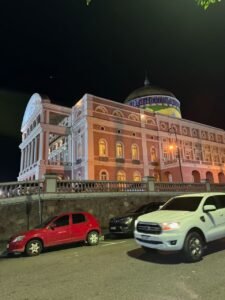
The state of Amazonas, in particular its capital, Manaus, has exerted a magnetic attraction on me since well before the start of my Brazilian wanderings. I may have written the same thing before about a different place, possibly in connection with Bahia. If so, it would be only right to clarify that the Amazonian pull has been different. The notions I had before arriving in Manaus were superficial: that the region had experienced a rubber fever in the second half of the nineteenth century, bringing much prosperity and making the state capital an enclave of luxury and sophistication in the middle of the jungle. I had always found this contrast intriguing, all the more so as the erstwhile opulence had manifested itself not only in the usual trappings of wealth and waves of immigration from far and wide, but also in a blossoming of the arts, in particular music and theatre. To indulge these noble pleasures to the full, the local government in the mid-nineteenth century saw fit to build a theatre, one that would match any European rival in proportions, grandeur, elegance and facilities. The resulting building, Teatro Amazonas, still stands there, proud survivor from grander times through the cruel decay that put an end to them.
It may be tempting to think of Teatro Amazonas as the folly of an opera-crazed Fitzcarraldo who indulged his conceit out of a private fortune. But the reality is both more mundane and more impressive. The theatre was the result of a public effort driven by successive local governments over a period of fifteen years from proposal to completion.
Admirers of Werner Herzog will have seen this peerless building in the opening scene of Fitzcarraldo showing Klaus Kinski’s and Claudia Cardinale’s breathless arrival at a performance by Enrico Caruso with Sarah Bernhardt. The majestic venue that hosts that stellar occasion is Teatro Amazonas, portrayed in its full glory after the loving restoration undertaken in 1975; the film itself was shot in the early 1980s.
In view of all this resonance, I was full of anticipation at the prospect of experiencing Teatro Amazonas; it became my centre of gravity even before I landed at Manaus.
As the plane lost altitude on the approach to the city, a confluence of rivers came into view, and it was a spectacle I will not easily forget. I cannot imagine how anybody could behold the view I saw with anything other than a feeling of awe. Nothing had prepared me for the scale of the two rivers meeting before my eyes. To call them colossal would fail to span their monstrous immensity. They were two brown oceans saluting each other in an encounter of titans, dwarfing into insignificance everything else, even the green infinity of the rainforest that surrounded them as far as the eye could see. It was no time for cartographic niceties, but later on I checked on the map and found that the meeting of colossi I had seen was the Rio Negro flowing into the Amazon.
Arrival was disconcerting. Of the three magnets that had attracted me to the place — the rubber-era grandeur, the jungle, the river — none of them was visible along the route from the airport to my accommodation. Instead, what greeted my eyes was, to put it politely, on the side of drab, and not very well kept at that. Throughout the ride I wondered whether, hot on the heels of Natal, this adventure was going to prove another damp squib. Things improved when I reached my lodgings. I had chosen thriftily, but not unwisely: I had made sure that I would have a view of the jungle, with some river thrown in. Admittedly not the wildest stretch of jungle and not the Amazon itself, but enough forest and river to give me a sense of awe the first time I looked out of the window — and every single time after that.
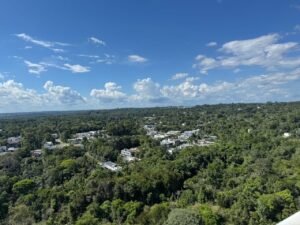
Although I had known it before arriving, I still felt the need to double-check to believe the fact that the part of Manaus I was to live in was called Ponta Negra, the same as my former neighbourhood in Natal. What is more, my new building had roughly the same orientation and lay at roughly the same distance from the water as my previous quarters in the Potiguar capital.
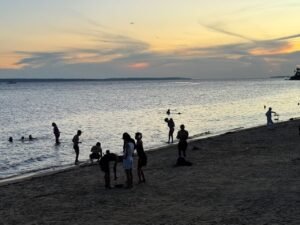
The radical differences — the beach lying on the banks of the Rio Negro rather than on the Atlantic Ocean, and this new Ponta Negra at the northern edge of the city rather than the southern — did little to allay the sense that the geography was stuttering on me. In both places, the experience of approaching by road with the water on the left was identical, as was that of leaving the building to breathe in the waterside breeze and take an evening walk along the shore. To complete the coincidence, in both places there lingered the same feel of a fraying promenade culture left over from some bygone season of gentility.
Apprising myself of the layout of Ponta Negra, doing the essential shopping every arrival in a new place requires, catching up with backlogged work —all of this was a preamble I went through with an inner breathlessness. The knowledge that Teatro Amazonas was now within my reach was a call I could not resist for much longer. As soon as enough duties were discharged to make it feel not too much of a frivolity, I headed to the historical centre of Manaus. And there it was, the second overwhelming sensory experience the state of Amazonas had in store for me. This one was not a surprise, but something I had previously known about, studied and long anticipated.
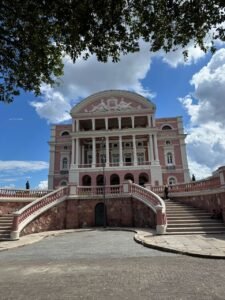
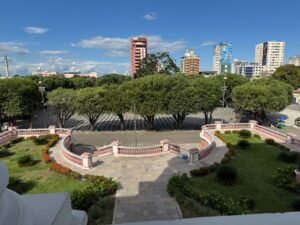
The theatre looks down with disdain on its neighbouring underlings. In front of it opens a tree-lined square, called Largo de São Sebastião, which is flanked by low-lying traditional buildings and, a little further off, a few multistorey ugly ducklings from more recent times. Although an inveterate avoider of organised tourism, I make no apology for a willing capitulation: I bought a ticket for a guided visit of Teatro Amazonas.
The visit is well organised. You are asked if you understand Portuguese and they place you in a group according to your answer. The groups start at regular intervals without too much waiting time. I will not attempt to describe the myriad beauties that grace this magnificent building. I would not be equal to the task. Suffice it to say that from that day onwards I wasted no opportunity —nay, I manufactured every possible opportunity— to go back.
An obvious excuse was provided by the concerts of the Amazonas Philharmonic, but these, sadly, were few and far between, and the programmes were not always appealing. Information about them was bizarrely hard to come by, requiring almost daily visits to a seldom-updated website and, on one occasion, an email to the city’s secretariat of culture.
The first concert enabled me to take the measure of the orchestra. I found it to be blessed with excellent musicians largely left to their own devices. Absence of leadership was plain to hear in the slack coordination between the sections, diverging intonation within the woodwind and within the brass, and frequent choices of the most comfortable tempo over the most effective one. The two works in the programme —Liszt’s Les préludes and Tchaikovsky’s First Symphony— had their lustre dimmed by these shortcomings. Dimmed, but not extinguished. It would take more than that to obscure the sheen of that wonderful music. The individual players’ musicianship, the appreciative audience and, of course, the sumptuous venue and its superb acoustics ensured a grand, fulfilling experience.
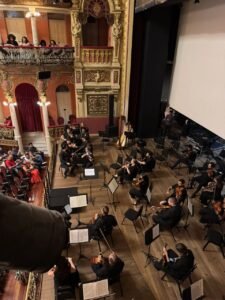
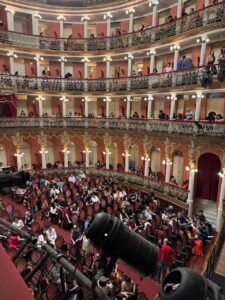
I will say nothing about the second concert. The third was not a concert, but a ballet, and not any ballet, but Giselle. This work is close to my heart for several reasons, among them the fact that it was Giselle that the National Symphony Orchestra was playing when I first joined it in La Paz, aged fifteen. Another special attribute is the long, elegant viola solo in the second act, which was to fall to me to play when I later became viola principal in said orchestra. Seeing that the Amazonas Philharmonic had planned a series of performances of Giselle, I wondered who was going to play the solo. The viola section I had heard the first time was strong, but I had noticed two anomalies in it. One was that the principal, an evidently experienced musician, had stumbled slightly on the rhythm of the brief solo at the end of the third movement of Tchaikovsky’s symphony. The other was that the assistant principal, a woman in her early thirties at most, showed a total physical immersion in the music she was playing. Subtly, without any showy theatrics, she seemed to surrender herself to her part with every cell in her body, allowing the music to carry her into an all-immersive dance. I could not hear how she was playing —nor are we supposed to be able to pick out an individual player within a section—, but I had not the slightest doubt that this assistant principal was no ordinary musician.
Now, it is a well-known fact of the profession that, if there is a solo in any orchestral section, it is the principal who will play it. Orchestral hierarchies are not quite as strict as those in the army or in the diplomatic service, but they are not far-off. And yet, something told me that this orchestra might make an exception for Giselle. I booked tickets for two out of the four performances, and I chose seats as close to the orchestra pit as I could find.
Adolphe Adam’s Giselle is as tuneful, graceful and mellifluous as it is fair to expect of a French ballet of its time (1841). Hearing it again for the first time since La Paz, I was filled with memories of a squandered youth in a now squandered city. The orchestra —or, rather, its conductor, even though now it was a different one— did nothing to alter my first impression of a top team without suitable leadership. Onstage, the assurance of the soloists and corps of the Ballet Alvaro Gonçalves took me aback. Giselle herself, Albrecht and, especially, Myrtha the Queen of the Wilis were entirely convincing. Come the second act and the celebrated pas de deux, with that sense of inevitability of those beautiful things of life that were always meant to happen, there began the C major arpeggio that opens the viola solo. The tone was too clean, too acqueous, the rubato too capricious, the vibrato too subtly dosed to come from anyone other than the assistant principal I had previously spotted. Sure enough, it was her. Institutional stricture had made way for art, and it had done so by an elegant expedient: the principal was absent, presumably on some kind of furlough, and the assistant principal had taken his place. The solo progressed with an artistry that was difficult to believe. Perfection is not possible, we know that, and arguably it is not even desirable. But the unblemished execution of this extended passage aroused a sense of the most complete fulfilment coupled with disbelieving wonderment: would it be humanly possible to play this solo any better than that? It was hard to imagine it. Back home that evening, I did an internet search and found that the viola player’s name is Gretchen Labrada and that she comes originally from Cuba. With such a Schubertesque —or Goethesque— first name, and the seal of completed hard work in her surname, all along she had been destined for artistic excellence. Long may she thrive.
The deep impression caused by Gretchen Labrada’s solo left me sensitised to the aesthetic charge in Adam’s Giselle. Both evenings I attended, the rest of the second act stirred inner responses that reached beyond what a piece of nineteenth-century entertainment might have been designed to set off.
Giselle’s after-death reunion with her beloved Albrecht put me in mind of the possibility of a dimension where impossible encounters with our dear ones become possible. I thought, as could not be otherwise, of the reunion I dream of every day of my current life, one which today’s fundamentalism makes impossible but which natural law says ought to occur sooner or later. And I remembered another death-like separation imposed by zealotry and enforced through blackmail. With an aching heart, I wondered if such a dimension exists —where what human perversity has separated can come together again. If it did, I wondered, how could one enter it? Would it be in this life, or would it be beyond? If that dimension did exist, I thought, and if it could be reached, the longed-for reunions would have to be permanent, not a fleeting joy that leaves an even grimmer pain in its wake. They would have to last forever. That being so, I thought, the dear ones thus regained would speak to me with sad voices and sad eyes, because eternity is a sad thing. It is happiness that is, always, but a passing spark.
Giselle marked the peak of my romance with Teatro Amazonas. I did not attend another performance after that —the programmes did not warrant it—, but I continued to frequent Largo de São Sebastião for the sake of admiring the building from the outside. As a matter of fact, I went as far as staying an additional twelve days in Manaus, abandoning Ponta Negra for a cheaper place in the centre of town —in order better to explore the historical heart of the city. Invariably my perambulations led me to the Teatro, but my urban ramblings extended over the whole area. I wandered semi-randomly, not minding in what direction I went as long as I did not stray outside the beauty —the tasteful designs from the rubber era.
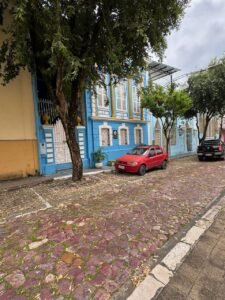
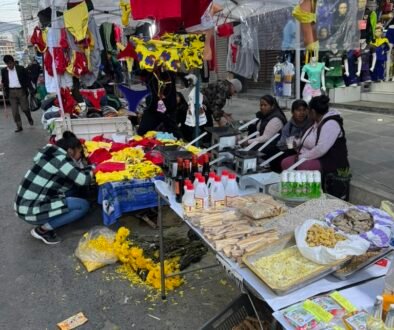
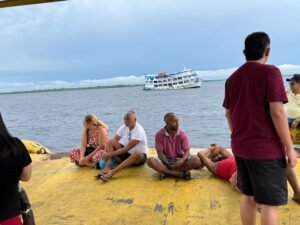
Many a time an attractive side street would allure me into it, or a graceful building would entice me to stop to contemplate it and, if I remembered, to take a photo. I had to explore only a little at a time, because the combination of heat and humidity made walking uncomfortable after a few minutes. But I managed to pay regular visits to the municipal market, whose tourist-aimed handicrafts I left untouched but whose inexpensive Amazonian cuisine I did sample. Close by, the old port is still fully functional, acting as a hub for a thick web of regional transport. The ticket stalls and the piers are awash with signs advertising the destinations available —long, euphonious placenames that make you wish you had all the time in the world to venture into the depths of the state of Amazonas.
All said, I did in Manaus everything I had gone there to do. Nevertheless, a sense of inconclusiveness made me regret departing. Life is short, and getting shorter, but I cannot rule out a second visit.