Bahia
Am I a Brazil lover? An objective look at the story of my life would produce deeper ties to three other countries. Why am I not writing about them instead of lavishing so much attention on Brazil? The answer is multifaceted.
I did write extensively about rural Northumberland while I lived there. My blog A Northumbrian Diary lost its reason for existing when I had to leave that beautiful part of the world. Years of Pilgrimage is not only about Brazil — I write about the places my wanderings take me to. It is only in the last few years that I have learned to discipline myself to write more-or-less regularly, and this has found me mostly in Brazil. As to love — yes, of course: bonds of affection have grown and keep growing as my stockpile of Brazilian experiences mounts. But I would qualify: more than a Brazil lover I am a Brazil thanker. My deepest bond is one of gratitude towards the country that has kept me safe and has kept me sane over the most difficult years of my life.
That exordium seemed necessary because of the turn of phrase I wanted to open this chapter with:
Every Brazil lover dreams of Bahia.
History, geography, gastronomy and people give this state a place close to the soul of Brazilian identity. And, on a lighter note but not unrelated, Bahia is a favourite holiday destination for a majority of Brazilians and for very many non-Brazilians too.
By no means a trend-follower, I had my own reasons to dream of Bahia. One was that Bahia is a byword for the Northeast, and northeast is the direction that leads me back to where I came from. All the time I have been writing these pages I have been somewhere southwest of the place that first put in my head the notion of Northeast — that is, the Northeast of England. It could be said that two and a half decades of residence in that ur-Northeast have made me a Northeastener at heart, no matter what theoretical midland the place I call home might be to the northeast of.
A less simple explanation, as with other aspects of my life, lies in literature. Jorge Amado is the anointed spokesman of a Brazilian Northeast in which Portugal meets Africa and Amerindia, forming an overpowering syncretism in which the historical battles of culture, race and economy rage on despite a nominal truce to which none of the parties shows much compliance. Easily the most widely read Brazilian, and certainly the first Brazilian I ever read, Amado writes about the Nordeste in such a way as to leave the reader in no doubt that therein lies the throbbing heart of Brazil.
The Brazilian Northeast, strictly speaking, is a vast expanse in what is a very vast country. If the word were employed in its literal meaning, it would embrace too large a conglomerate of cities, states, people and things to be a useful term. In everyday usage, however, Nordeste tends to mean the state of Bahia.
Even this — the fifth largest state in the Brazilian union, with an area roughly the size of France — is wider than what the word usually designates. What Brazilians most often mean by Bahia is its capital, the city of Salvador. Before we rush to point fingers for careless word use, we might bear in mind that even Jorge Amado, official interpreter of the soul of Bahia, is not above writing “the city of Bahia” to mean Salvador (this happens, for instance, twice in The Death and the Death of Quincas Berro d’Água).
Spelling can be said to be an issue, too. “Bahia” is the old Portuguese orthography for “bay”, the current one being baía. After prolonged debate, the matter was settled in 1943 by Brazil’s language authorities, who ruled that toponyms predating their spelling reform should retain their historical form. Gentilic adjectives, however — words denoting the people of a place — were to have their spelling updated, hence the apparent incongruity in the use of baiano, without the H, for somebody associated with Bahia. While on the subject of gentilics, it would be remiss not to mention the impressive word Salvador boasts for its people: soteropolitano, readily translated as Soteropolitan.
You might also query, as I do, why Bahia is deemed a bay and not a gulf. Perhaps, to the pioneering Portuguese seamen who went about christening their discoveries, this sea inlet looked wider than it proved to be once the cartographers had done their job. Or, why not, perhaps they had an ear for phonetics and rightly judged that future generations would enjoy pronouncing Bahia more than Golfo.
Whatever the history, the geographical fact is that the Bay of All Saints is a deep inlet of the sea carved into the east coast of the continent. It is carved upwards, so to speak — from the bottom up, parallel to the coast. Broadly speaking you might describe it as an upside-down U shape, except that there are islands in the middle that muddy the waters somewhat.
I had never before been to a place that looks and feels so much like its map. The bay is narrow enough to show its shape to the naked eye. You can stand at the Barra point and see the island of Itaparica on the other side, where the sun sets. You can look to your right and see, to the northwest, the water widening past the island. A few minutes’ walk to your left and you come to the Barra lighthouse, at which point the land does a right angle and you are looking no longer west, but due south. If you keep hugging the coast away from the lighthouse — too far to do on foot — you will go across the Rio Vermelho quarter and, eventually, at Amaralina, the lay of the land will make you change direction again, and you will be facing the Atlantic head-on, towards Angola. Geography tells you Africa is a long way off, but race, religion, dance and music make it feel close. So does a monument named Angola, not after the country but after a whale that in 1998 whalewatchers spotted and photographed off the Angolan coast and, twenty-one years later, the very same whale, within sight of Salvador.
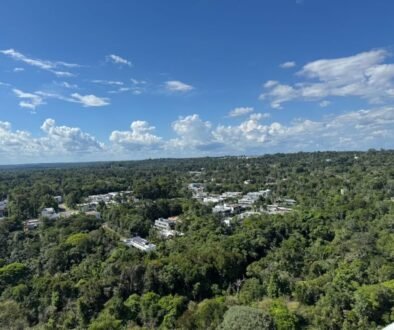
If it seems odd that you should be able to watch a sunset over the sea, even though you are on the eastern edge of the continent, a glance at the map will show you why. Salvador is a peninsula, surrounded by water on three fronts. The Atlantic has the mass and the power, with millennia of world history behind it. But the countering force is no less potent: the intensity of colour, the inner energy, the spirituality, the deities, the local tales and the local history are on the west side, on the bay, facing the continent. This is where most of my Soteropolitan experience took place, with a smattering of south too.
The richest concentration of colonial beauty is, obviously enough, in the historical centre. Up on the heights of Cidade Alta (High Town) is the area called Pelourinho, where the official buildings of Portuguese Brazil survive in varying degrees of preservation. The breath-taking density and grandeur of the architecture can best be understood if one remembers that Salvador was the colonial capital of the Portuguese dominions. Down a very steep bank is Cidade Baixa, where the old customs house — the nineteenth-century Mercado Modelo (the municipal market) — is located, diagonally opposite an impressive church, Nossa Senhora da Conceição da Praia. To move between Pelourinho and Cidade Baixa, the providence of a local entrepreneur in 1873 built the world’s first urban lift: Elevador Lacerda. It is a beloved landmark, both for the views that can be admired from it and for its own Art Deco design (it was comprehensively refashioned in 1930).

On the south end of the peninsula is the port of Barra. No longer a functioning port — unless you count the fishing boats whose primary purpose might equally well be to enhance the postcard effect — here you are greeted by the illustrious naval past of Salvador, in the form of splendidly built jewels such as the Barra lighthouse and the adjacent Fort St Anthony, Fort St Mary and Fort St James. They were erected by the Portuguese to protect their colonial capital from the incursions of the Spanish, the Dutch and any other marauders.
Barra is now a thriving leisure haunt, throbbing with walkers, runners, showers-off, cyclists and pedlars, all a feast to behold. Both in Pelourinho and in Barra, one of the richest rewards to the eye is the beauty of the people. Mostly of African heritage, they display a predominance of slim, tall, fine-featured women and men. The warm weather — and, perhaps, an awareness of having much to be admired — encourages the promenaders to dress scantily. The effect is not one of display so much as of ease: skin exposed without insistence, bodies carried with a natural confidence. It is difficult not to be struck by the beauty of it.
Observing the comely procession, one cannot but notice some innovative solutions for carrying a mobile phone while wearing a single figure-hugging garment. One lady had her phone on her tummy, held in place by the tightness of her dress. Another carried it in her cleavage, where any attempt at robbery would of course amount to a double offence.
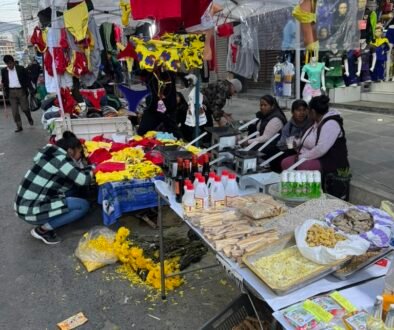
Salvador being, for all its splendour, in the real world, it could not fail to sound its own discordant notes. One of them is caused by the hustlers, of whom a particularly aggressive variety concentrates in Barra. They offer to sell you trinkets, they ask you for money, or — and this seems to be a local speciality — they offer you the gift of a ribbon. My landlord had warned me about this. They tender the ribbon quite insistently, stressing that it is a gift, more often than not from the bottom of their heart. What happens if you accept, I was told, is that you are then in their debt, and you are asked to repay it in any of a number of ways. My landlord intimated that such demands could go on to become quite aggressive. Thanks to his timely advice I was armed with the determination to refuse the ribbon, no matter how doggedly it was proffered.
Another false note disrupting the harmony is the overcharging in restaurants and shops. It is endemic, and it is targeted — at tourists, of course. The difference between a tourist and an impecunious self-employed nomad may be too subtle to expect restaurant or market-stall staff to perceive, I allow. As to what renders me recognisable as a foreigner, I will not go into that this time.
Back in the south of Brazil, reminiscing about these experiences in conversation with a chatty young man from Salvador, he justified the mercenariness of his fellow Soteropolitans as an imperative arising out of poverty. With little in the way of job opportunities, people have to be creative to eke out a living.
Ineluctable necessity. One would like to believe that, if only out of respect for the people of one of the best places on earth — even though neither the traders at Mercado Modelo nor the restaurant managers by the Barra promenade looked particularly hard up to me. Appearances can be deceptive. Some statistics highlight the deprivation in sectors of the city’s population. Others point out the opposite. I look forward to being convinced.
To the east of Barra is Rio Vermelho, a quarter well known for nightlife and bohemia. Most nightlife in any city starts after my bedtime, so it passes me by. As to bohemia, as far as I am concerned the term is misapplied to Rio Vermelho. All I saw there in the evenings was crowded restaurants and bars, some of them blasting live music of a fairly commercial variety. Focal point of leisure and entertainment, perhaps; bohemia? Not in my book.
One of my visits to Rio Vermelho was on a Friday evening, in the company of my younger sister, who had joined me for a few days. We sampled the local acarajé at a well-known specialist outlet, very close to Tati Moreno’s bronze statue of Jorge Amado sitting on a bench with wife and dog. Not bad, but not as good as the acarajé we had tasted at a less famous spot in Embú das Artes, São Paulo state. We then decided to walk east to assess the area’s famed vibe.

After a few minutes we noticed, a little ahead of us, a scrawny man with every appearance of being one of the homeless of Salvador. I will call him the Pedestrian.
He had been edging off the street towards the pavement, trying to get out of the way of an approaching car. To our disbelief, the car was not stopping; it was going slowly, but fast enough to shove the Pedestrian — and shove him again before he could step aside. Then the traffic lights changed and the car had to stop, allowing the Pedestrian time to get off the road and give the driver a well-earned earful. As the driver answered in kind, the Pedestrian used the carrier bag he had with him to punctuate the exchange with a thwack on the side of the car. It was not a major thump — it sounded like there was food in the bag. But it was enough to provoke the driver into rushing out of his car and lunging at the Pedestrian, who by now was running towards the safety of the nearest restaurant.
The driver, a heavily built, athletic man, caught up fast, and he discharged blow after blow on the hapless Pedestrian. The changing colour and swelling shape of the Pedestrian’s face indicated that he did not have long to live if he was not freed from the murderous clutch.
It was at this point that I, who until now had restricted my participation to remonstrating indignantly with the driver, rushed forward and began to pull at the arm that was wringing the Pedestrian’s neck. It perplexed me to see how little effect my pulling was having. The driver had the build of a gorilla, with the round close-cropped head to go with it. His arm was made of solid steel and its owner did not deign to so much as look at me, but my intervention must have got on his nerves, since he made a sharp swatting movement that pushed me several steps back. This show of brute force had a sobering effect, giving me a new measure of the violence I was involving myself in. Only now did I hear my sister’s horrified screams, begging me to move away. Luckily, by now, enough of a circle had formed around the scene to persuade the driver to let go of the Pedestrian, who, no less luckily, was still alive. The driver walked calmly back to his car, not before I had had time to take a picture of his number plate.
My sister was livid in every sense. She said that she had been shouting at me not to get involved, and that when I went for the driver’s arm she had been tugging at my clothes, trying to pull me out of the mêlée. I had noticed neither.
As to the Pedestrian, he had not only survived the attack; he had recovered enough of his composure to come to thank me for my efforts and — why did this surprise me? — to ask for money for his evening repast. That tactical shift turned my sympathy for him into umbrage. Writing these lines a year and a half later, I reproach myself for judging him harshly. He was, by all appearances, destitute, and ought not to be blamed for seeking aid where he had seen sympathy.
On the way back, my sister and I went over the incident from every angle. She was indignant at me for not assessing the dangers in advance. I tried to explain that I had felt impelled by a flash in my mind of a report in the next morning’s news that a homeless man had been killed in a street attack, and the knowledge that I had been at the scene and had done nothing to stop it. This cut no ice with her. Regardless of the rights and wrongs of the situation, she reasoned, a man of the driver’s manifest ilk could well have been armed. He had had all the appearance of a renegade soldier or policeman, with the training to go with it. She made me promise that never again would I be foolish enough to intervene in any street violence.
I felt sorry for my little sister. She had come to celebrate her birthday with me, but I had given her a near heart attack. She was shaken and I was contrite. Fortunately for both of us, Pelourinho provided a redemption. Over lunch the next day — this was her birthday — we heard that a drumming association called Olodum, much respected in the area, was having a performance in the evening. The young people who gave us this information spoke of Olodum in admiring tones. The show was going to be in the street, free for all.
The meeting point was to be a bar situated at one of Pelourinho’s quieter corners. When we got there at the designated time — I cannot say “advertised”, since all had been by word of mouth — we found the place far too small to contain more than a handful of drummers, even without their drums. Soon we noticed that, although it was raining, a growing number of people in red T-shirts was assembling outside. As soon as the drumming began we joined them and the gathering became a parade, moving steadily towards Olodum’s headquarters. We paraded with them, drummers all around us. The streets involved were closed to traffic for the occasion. The procession stopped outside Olodum, at a cordoned area where security was letting in only the drummers and selected VIPs. My sister and I stayed outside.
It was cold and the rain was persistent. I had an umbrella, but many of the other spectators were not so equipped, though they did not seem to mind getting wet. The drumming was well rehearsed and confidently delivered. There was enough variety and vitality in it to hold one’s attention through quite a long performance. And yet the main interest, at least for me, was in the watching. There was no dancing involved, but there was a palpable community spirit in the performing ensemble and in the rapt audience. It was an occasion where the locals seemed to be facing themselves, wordlessly celebrating being who they were and being in their town, their bay. If any tourists were about, they were inconspicuous, my sister and I being probably the most noticeable outsiders. The birthday girl could not contain herself and let herself follow the infectious rhythms with every part of her body, whose litheness reminded me that she is a dancer by training. We were treated to several hours of drumming in the rain. I was grateful to Olodum for restoring the birthday cheer.
After my sister left Bahia, my outings became less adventurous. Once the extortion at Mercado Modelo had taken the sheen off Cidade Baixa for me and the street violence had put me off Rio Vermelho, any jaunts became restricted to a stroll along the Barra seafront or a trip up to Pelourinho.
In Barra, the sea-watching experience is no less eventful than the intoxicating people-watching. The sea is a never-ending stimulation. Its colours change with the time of day, almost by the minute. The sunset over the bay is a daily marvel which the locals at Porto da Barra hold in high esteem. Many stop to watch the sun’s descent over the bay, and some seem to come from other parts to witness the spectacle. This may be the only situation in which you are likely to witness two or more Brazilians speaking in hushed tones, or even not speaking. They stand or sit at their chosen viewpoint with a reverential attitude. The sun’s downward progress at this time is surprisingly fast, holding the unwavering attention of its spectators. Each degree of descent sends new shapes and colours onto the water’s surface and the surrounding sky. When the last edge of the holy fireball has sunk beneath the horizon, it is common for these sun devotees to break into applause and cheer in appreciation of the show nature has put on for their benefit. Although too self-conscious to applaud, I have been one of the enthusiasts, organising my afternoon routine around the gradually shifting time of the pôr do sol. Few times have I felt a stronger kinship with any Brazilians than I have among this sunset-loving audience.


From a certain height, which is easy to reach in this town of a myriad ups and downs, it is easier to observe the maritime traffic in the bay. The fishermen’s boats, numerous if you are standing by St Mary’s Fort, are not to be seen from up here. Either they head due south hugging the shoreline or they only go out at some ungodly hour when I cannot see them. There are leisure boats aplenty, their closeness to land a possible indication of a desire to show off. Their helmsmen seem to pride themselves on the foamy wake they leave behind, since they rarely go in a straight line, preferring instead to draw coquettish white curves in the blue water.

As to Pelourinho, a bus line went straight up to it from my nearest stop. To have the luminous blue of the bay on the left on the way up, and the iridescence of its dusk on the right on the way down, was half of the treat. The other half was Pelourinho itself. The exhilaration of wandering its cobbled streets, its anarchic geometry, its steep topography and its brightly painted rows of colonial- and imperial-era buildings was inexhaustibly enchanting. Its Afro-Brazilian density posed a perfect counterpoint to the openness of Barra.
Although no excuse was ever needed to go to Pelourinho, twice I went with a specific purpose: to watch the Balé Folclórico da Bahia. I had seen its posters when walking past Teatro Miguel Santana with my sister, but, as I told her at the time, it had seemed too much of a tourist-oriented concoction to be of much interest to us. But then time went by and, as I began to feel an anticipated nostalgia for the city I was going to leave imminently, I decided to give it a try.
The first time especially, I was taken aback by the simplicity of the theatre, of the sets — that is, no sets — and of the music ensemble, consisting of two drummers and one singer. The dancers’ outfits were the loose-fitting baiano tunics for the women and no-nonsense shirts and trousers for the men. No frills anywhere — in other words, the opposite of the showy frivolity I had unjustly presumed.
The music sounded much more African than I had expected and the programme had a cleverly judged balance between contrast from one piece to the next and an overall crescendo. Usually, when watching a dance show, I have to home in on one of the dancers who executes the movements with more precision and grace than any of the others — I call it the Sibyl Vane approach. In this case that was warranted only with the male dancers, the female side being so homogeneous as to make such selection unnecessary. There were moments of humour, of aggression, of tenderness, of ecstasy, and at all times there were energy and character in torrents. There was a Pantheon of the Orixás evoking the creation of the world by the principal Afro-Brazilian gods; there was a fishermen’s dance featuring a ravishing ritual for the undisputed goddess of these parts, Yemanjá; there was maculelê, which is danced with sceptres; capoeira, which is both a dance and a martial art; and there was a grand finale, samba de roda. The build-up of energy had been so precisely paced, and so much care and affection had been lavished in the conception and delivery of the dance and the music, that the effect of this climax was simply overwhelming. A lump in my throat is the most I will admit to spare my own blushes.
Having immersed myself in Salvador with gusto for the best part of two months, it is possible that my impending departure made the experience of the Bahia Folk Ballet more emotional than it might otherwise have been. I went twice, within a few days of each other, and the second time was on my last night in the city. My presence at that show, in the heart of Pelourinho, was my farewell to Bahia, or Bahia’s prodigal way of sending me off. That samba de roda was a valediction that will reverberate in my mind’s eyes and ears for a long time.
Before the Portuguese landed here, an indigenous name for this place was Kirimuré, meaning «great waters» or «great inner sea», after the bay itself and the many rivers and streams that flow through the area and into the sea. I know that I am not the first to have come to this bay and to have perceived in it a unique spirituality, a purity of energy that passes through one’s mind and body with a restoring, cleansing effect. The Afro-Brazilian religion of candomblé associates this power with Yemanjá, Queen of the Sea, Mother of the Waters, Mother of the World, Universal Mother. Yemanjá is also a siren, seductress and protectress of all seamen — unless she catches a fancy for one of them, in which case she drags him to the bottom of the sea and makes him her husband. She is venerated in Salvador, particularly in Rio Vermelho where every second of February a major festivity is devoutly celebrated in her honour.
Wishing to learn about Yemanjá and about candomblé in general, I read up on terreiros — the worship places — and more than once was on the point of going to one of them. Every time I lost my nerve, deflated at the prospect of being seen as a religion tourist, yet another foreigner coming to catch a taste of the natives’ exotic religion. I knew my interest to be genuine, but a reluctance to cut that kind of figure among the faithful was the inhibiting factor. The literature makes it clear that this religion is inextricable from ethnicity, and it was foreseeable that I would stick out like a sore thumb. Was it genuine respect that deterred me? Or was it a shallow self-consciousness? Probably a combination of both. In any case, the spiritual power of the Bay of All Saints did not pass me by. I felt drawn to it, I received its blessing gratefully, and I left Bahia feeling, in some way that words can barely touch, cleansed.