South I
October 2020
Darkness had fallen over Porto Alegre. The driver, Edson, wore a mask of world-weary apathy that could have been a permanent fixture of his Sunday evenings. Doubtless it was tedium that impelled him to make conversation. On hearing my foreign accent he demanded to know my origin. The mention of my interest in Mario Quintana acted as a sudden tonic; he straightened up in his seat with a jolt of civic pride. “I met Mario Quintana!” he exclaimed. It emerged that he had, in fact, observed the poet from a distance in a café — a claim whose modest plausibility made his pride all the more touching. He insisted on a detour to show me the local bard’s last dwelling, grandly gesturing towards an ochre landmark to point out the exact window of the master’s room, his directions muffled by a regional accent I was encountering for the first time, and by the pandemic’s mandatory mask.
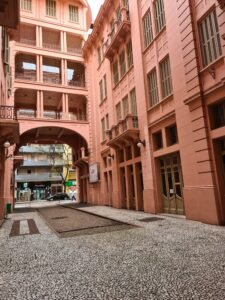
Once I had dropped my baggage, the next challenge was to find somewhere to eat. Rua dos Andradas was deserted and so were all the neighbouring ones. Two men at a corner shop took the matter of my dinner seriously and gave me assurances that a place just around the corner opened until ten on Sundays. Not this Sunday, as I found when I got there. Eventually I located an Italian place that served me a pizza which I devoured oblivious to the consequences. Hungry arrivals on Sunday evenings seem to be a feature of my wanderings. More than once I have been forced to play Russian roulette with the gluten for lack of any other option, as was the case this Sunday in Porto Alegre with no untoward consequences.
On Monday morning, the cobbled Rua dos Andradas was abuzz. The population looked less diverse than that of São Paulo. I was struck by the clusters of men, street traders all of them, of a gleaming, almost blue complexion, unlike any Brazilians. Is this where the African refugees concentrate, I wondered? I knew that there was also an influx of Haitian immigration into Brazil, but I was not picking the slightest trace of French in these tradesmen’s speech. Suddenly, as if goaded by an electric prod, all the sellers to a man gathered their wares at a speed that did not seem possible, taking no time to leave the pavements as clean and empty as if no trade had ever taken place there. In their wake arrived a police contingent, too late to do anything about the illegal trade they seemed to be charged with preventing. They found that no such thing was taking place, whatever intelligence to the contrary may have brought them here. The street had become quieter. Perhaps in solidarity with the banished street vendors, a lone busker was doggedly getting through the viola part of a Haydn string quartet.
It was a relief to be charged more reasonable prices for food than in São Paulo, even though the fare on offer was limited. Dining at Rua dos Andradas, at the end of a cheerless repast I found myself caught in a classic nightmare: new city, dinner eaten, no money to pay for it. I had forgotten to bring my wallet. I did have my mobile phone on me, and a bank app on it, but the bank’s app, just to complete the perversity of my nightmare, was not working at this time. In any other part of the world I know, this predicament would have given rise to unpleasantness. But this is Brazil. The manager was quick to come out to say it was absolutely fine, I could go and fetch my wallet in my own time. Needless to say, I came back at once, settled my bill and promised to return to dine the next day. I was true to my word.
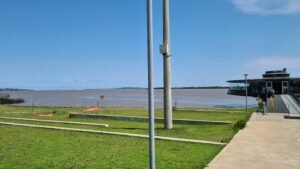
On Tuesday the spacious silence along the lakeside brought fond memories of Belgrade the previous year. Before the pandemic, before the calamities life was to wreak on me, the Sava had met the Danube in front of my eyes. Here in Porto Alegre, the meeting of lake Guaíba with the Atlantic took place too far down south for any eyes to see, but not for the mind to know that the water I was watching and smelling could, given half the chance, carry me up northeast, to Newcastle upon Tyne.
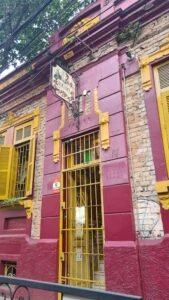
Later I walked to Cidade Baixa in search of a coffee shop that was the subject of fulsome reviews. Doing my best to ignore the 1980s eyesores and to focus on the beauty, as I entered the new neighbourhood I observed the grandeur giving way to bohemia. There was plenty of ugliness to sift through on both sides, but the character of Cidade Baixa was undeniably its own. Sadly Café Agridoce was not serving customers on the attractively decorated premises that beckoned as you peered from the pavement; only takeaway service due to health and safety restrictions. Their coffee, which I drank seated in a public bench nearby, lived up to the good press. Agridoce will be a place to revisit should I come back to Porto Alegre in less austere times.
I had planned to take my time on my way out of Brazil, stopping at a couple of picturesque destinations I had identified, but on my last night in Porto Alegre I bowed to reality: this was no time for tourism. My crossing had a purpose; any unnecessary stops would be shilly-shallying. I made the necessary schedule changes and set off from Porto Alegre.
The contrast between the ponderous grandeur of Porto Alegre and the modernity of downtown Foz do Iguaçú could not be starker. The appearance of prosperity in Foz was undisturbed by the pandemic, to judge by the ubiquitous construction work, not least in the building where I found myself.
Foz do Iguaçú is the Brazilian portion of the nucleus where Brazil, Argentina and Paraguay lock arms in a triple embrace, hence the area’s byname — Triple Frontier. The locale is known as a trade hub, driven to a large extent by the commercial thrust from Ciudad del Este, on the Paraguayan side. Trade, however, unlike construction, had been brought to a halt by Covid.
Although there was no lack of open eateries, lack of variety in the menus and eye-watering prices put a damper on gastronomic pursuits. The size of the bill for my first dinner (188 reais in 2020) instantly determined that thenceforth economy was to be a priority. In pursuit of thrift I even was to venture once into the local vegetarian place, which fed me a spartan boiled rice with vegetables, grandly peddled as risotto.
The maps of Foz show a mosque in the city centre and a Buddhist temple slightly out of town, which for a population of just over quarter of a million seemed impressively cosmopolitan. Belying that impression, the street demographics did not show much diversity. That is, until I came across a contingent of women in austere black tunics and men talking in what could have been Arabic or Farsi. I wondered what had brought them to this border outpost. I was to be reminded of them five years later, when the Argentinian minister of homeland security, Patricia Bullrich, announced measures to safeguard her country against the presence of Hezbollah around the Triple Frontier. Was it them I had spotted? Was that unlikely-sounding threat even real? I would not for a minute equate muslim-style garb with membership of Hezbollah, and back in 2020 I discerned no reason why we might need safeguarding from the citizens I was seeing. But I admit that I was intrigued by their presence.
The Sunday Sabbath in Foz was less a day of rest than a total evaporation of the living. Even the busy Avenida Brasil stood hollow, leaving me to wander a ghost town. In this vacuum of activity, the search for sustenance became an exercise in diminishing returns; I recall only the hollow victory of an overpriced salmon in what surely must be the smallest sushi house in the world.
If any doubt remained, in the new week I was able to establish beyond question that the border crossing was closed on the Argentinian side. First I asked at the Argentinian consulate and was told that the Tancredo Neves international bridge was interdicted on the Argentinian side, as were all the other border crossings from Brazil to Argentina. The only available passage was from Uruguaiana, back in Rio Grande do Sul, to Paso de los Libres in the Argentinian province of Corrientes.
That is the official response, I thought; the reality on the ground is often different in far-flung places. Surely taxi drivers would tell me; they should be happy to tell me the finer points of cross-border traffic in a town whose economy relies on it. Not this time, I found. The laconism of their answers surprised me. Covid had sealed the lips of the chattiest profession on earth at this Triple Frontier. I would have to see for myself.
A gingerly taxi driver took me to the border and through the Brazilian customs post, stopping right past the last Brazilian guards on the Tancredo Neves bridge. The driver, seemingly nervous at the rumours of strict controls on the Argentinian side, was unwilling to go any further. He told me to get off and walk the rest of the way if I was sure I wanted to go on. As I approached the barrier on foot, an Argentinian guard came out of his cabin and walked towards me before I could get any closer to his side. In the bright mid-morning silence, I was aware of the intent gaze of my taxi driver behind me and of the stares of the other soldiers in the cabin behind the guard. The scene reminded me of the spy exchanges at Berlin’s Glienicke Bridge. The guard’s manner was polite, but his answers to all my questions were an impregnable “no”. His accent would have been nostalgic music to my ears but for the jarring profusion of negatives in every sentence he uttered. He confirmed that he could not let me through, and that the only border crossing allowing passage was further south, at Paso de los Libres (he patriotically mentioned only the town on the Argentinian side).
“Further south” was a way of putting it. The distance from Foz to Uruguaiana is 555 kilometres as the crow flies. If you were interested in the shortest possible land route, you might attempt a straight enough southward descent using a combination of Brazilian and Argentinian roads. But, as we are seeing, in October 2020 any incursion into the neighbour country was forbidden. Besides, if you had crossed into Corrientes you would not need to persist all the way to Paso de los Libres. Once on Argentinian soil, you would have essentially reached your destination. Any onward travel, say, to Buenos Aires, could be, for all you cared, as leisurely as the pandemic dictated, using any land, air or water route. But, as my border guard on the bridge was making abundantly clear, you could not do any of that. Although he and I were standing within metres of Argentina, the only way for me to enter any portion of his country would be to go and cross another bridge, located — keeping to Brazilian roads and relying on the coach network — over a thousand kilometres away. In the absence of any other option, that is what I undertook.
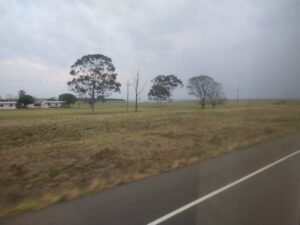
In contrast to Rio Grande do Sul’s claims to excellence — heroic past, good wines, thriving industry —, the views on either side of its roads were unremarkable. Rolling hills, soy fields, more hills, more fields. The famed cattle herded by intrepid gaúchos on horseback and the vast vineyards destined for lush red wines must have lain hidden from view somewhere.
Amidst the endless agrarian acreage, the stopover in Santa Maria came as an oasis. Its name had boded well, being my grandmother’s surname — the one on the maternal side, the only grandmother I caught a glimpse of before she, too, passed away. Besides this nominal family association, I was grateful to reach a town where the Brazilian craze for tall buildings had not completely obliterated the individuality of the place. The cobblestone streets greeted me as a token of a place’s respect for its past. So did the terrace of colourful little houses along Vila Belga on Rua Manuel Ribas. And so did the old-worldly manners of the locals, once I began to interact with them. The couple of days I sojourned in Santa Maria were what I needed to recover from my stresses. Twenty hours sitting in a coach had taken their toll, including a. persistent headache the like of which I had not experienced since the worst days of my Novocastrian nightmare. Santa Maria was my analgesic. I would gladly have stayed longer.
After that, the four-and-a-half-hour journey to Uruguaiana was quite bearable by comparison. The landscape did not improve, but the adrenaline rose as I became aware of the proximity of the river Uruguay. The knowledge that on the other side awaited the Argentinian province of Corrientes gave this nearness a sense of momentum.
My first impression of Uruguaiana was one of admiration for the geometrical layout of the streets and the neoclassical lines of the architecture around the main square, Praça Barão de Rio Branco. The ubiquitous wrecking ball had spared the traditional terraces, filling the visitor’s eyes with gratitude. The wide pavements enhanced the lordly dignity of the aged buildings, making the streets welcoming to the pedestrian. Clearly this was no ordinary provincial town. Back in the mid-nineteenth century, the original urban planners, inured to constant war, did not have leisurely walks in mind so much as the efficient displacement of military equipment and personnel, including cavalry. Uruguaiana is one of the first planned cities in Brazil, owing its regular chessboard design to a desire to make the place easier to defend. It was deliberately built away from the original location, which had been overrun by flooding. And its name does not refer, as the word might suggest, to anybody or anything from Uruguay: it is a compound of the name of the river with the name of the original encampment’s patron saint, Ana.
Less impressive was my accommodation. I had chosen it for the impressive river view shown in the advert, but that turned out to be a mirage; to enjoy that prospect you had to contort into the kitchen, a space so narrow that there was nothing else you could do there, not even cook.
The next day, Sunday, I went to look at the border, which, unlike in Foz do Iguaçú, is right by the city. Hefty pylons barred access to the international bridge. Did all traffic stop on Sundays? I looked for another crossing point, in case the ageing structure I had come to had been superseded. But there was none in sight, nor did the map show any alternative bridge. I would have to wait until the following day to understand the situation.
Finding food was not easy either. On Saturday a grocers had sold me basic supplies for Sunday’s breakfast, and on the way home a beer hall by the square had been kind enough to serve me an edible spiced chicken. But on Sunday no such kindness was to be had since the beer hall was closed, as was most of the city.
On Monday I went to the Argentinian Consulate. A stern lady assured me that the border was passable, but only if certain conditions were met. If you had the right documents, which I did, you could be allowed through, but only if you had somebody waiting for you on the other side, which I didn’t, and had a registered address in Paso de los Libres, which I didn’t. If your intention was to bypass the city and travel on southwards, as mine was, the registered address requirement would be waived, but you needed to have your transport arranged in advance, and — here was the crux — you had to bear in mind that travel between provinces was forbidden. She did not mention the Sworn Declaration her colleagues in Foz had warned me would be essential, nor the valid reason for travel which the border guard had advised me I would need to demonstrate. But she did not need to; she was making abundantly clear that the only available crossing between Brazil and Argentina was available for some, but not for me.
The beer hall was open again, so I went in for more spiced chicken. For a lone customer, lunch was a melancholy affair. Normally a place all to myself would feel like a luxury, but a sense of justice seemed to demand that a life-saving place such as this ought to have more customers. Where was everybody, I wondered. At home, I guessed, trying to work out a way forward past the stumbling blocks. Later, wedged in the capsule of my kitchen, I gazed out of the window as the afternoon light descended calmly over the river Uruguay. As it reflected the slanted sunrays, I fancied that it spoke to me. Atahuallpa Yupanqui’s lyrics came to mind: tú que puedes, vuélvete. Now the river seemed to be humming that for my benefit: You, who can — turn back! So, once more, back I turned.
With no international crossing to look forward to, the journey back to Santa Maria was a hollow affair, and the arrival an anticlimax. And yet, in my deflated state of mind I felt unaccountably light. The unrelenting thwarting of my plans had left me in need of something, but that something was not self-pity. I needed a pause to redirect my compass. Objectives had to be redefined, and itineraries redrafted accordingly. I resolved to stop at this congenial town for a few days. Here I walked, I thought, I ate, I watched the world — or such slice of it as this charming town afforded. Not for the first time, it healed me. Over the years that have elapsed since, I have preserved a grateful memory of the serene dignity of Santa Maria.
The coach ride back to Porto Alegre was the nadir in the series of anticlimaxes I had unwittingly stockpiled. If there were any views worth watching from the bus window, in my mind they just prolonged the grey stereoscope of roadside pictures that had fatigued my eyes across two states and from the western to the eastern end of Brazil. They interspersed with a phantasmagoria of empty streets, heavy pylons, polite soldiers and consular officers saying no, and, most recurrent of all, impassable rivers.
An overpriced flight brought me, tail between legs, back to São Paulo. My sister was gracious about it.